AI & Automation · Live demonstration
An AI that actually knows your documents.
Meet Nat, a knowledge agent we built as a demonstration on the National Construction Code. Ask a question in plain English and Nat searches a curated library of authoritative sources before it answers, then shows exactly where each answer came from. The building code is just our example: the same pattern works on your policies, standards and manuals.
The idea, in one line
A general chatbot answers from memory. A knowledge agent answers from your library.
Ask a general AI a specific question about your business and it will answer confidently from whatever it happened to learn in training, which is exactly how you get a wrong answer that sounds right. A knowledge agent works the other way around: it searches your approved documents first, answers only from what it found, and shows its working.
The demo · an example use case
Meet Nat, our demonstration knowledge agent.
Nat is the worked example we use to show the capability: an AI research assistant for the National Construction Code, built to help builders, designers, engineers and certifiers find and understand code requirements in minutes instead of hours. It does not replace professional judgement. It speeds up the research underneath it, and keeps every answer tied to an authoritative source.
 Nat
Live in Microsoft Teams
Nat
Live in Microsoft Teams
What Nat can help with
Ask about a requirement in plain language and Nat identifies the relevant provisions, explains why they apply, flags anything missing, and cites the documents behind the answer.
Identifies the provisions
Pinpoints the code clauses that actually apply to the question, rather than a generic summary.
Explains why they apply
Sets out the reasoning in plain English, so the answer is usable, not just a reference.
Flags what is missing
Asks for the project details it needs, and says when an Australian Standard must be consulted separately.
Cites the sources
Shows the documents behind every answer, so a professional can verify it in seconds.
See it working
Four steps, from a plain question to a cited answer.
These screens are the actual demo, running in Microsoft Teams. Your agent looks and behaves the same way, on your documents.
Ask in plain English
Someone asks Nat a normal question, with no clause numbers and no search syntax. Here: how high does waterproofing need to be.
No expertise in the code required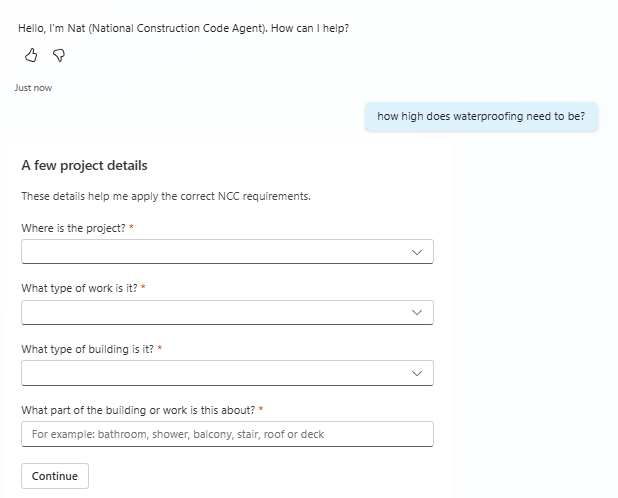
It gathers the essentials first
Many code questions cannot be answered safely without knowing the project. Nat asks a few short questions, the state, the type of work, the building type and the element in question, so it applies the right requirements instead of assuming.
State · work type · building type · element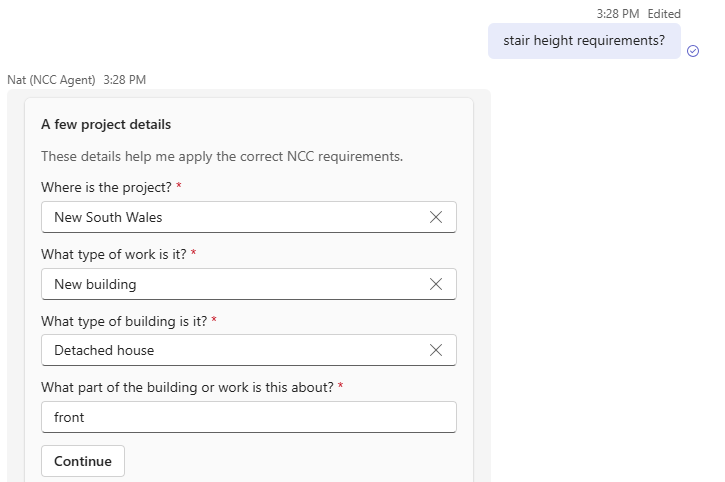
It searches a curated library
Nat searches only a curated set of authoritative sources, the current NCC, NSW context and practitioner guidance, not the open internet. Each source is prepared, version-labelled and kept current.
Four approved knowledge sources, all ready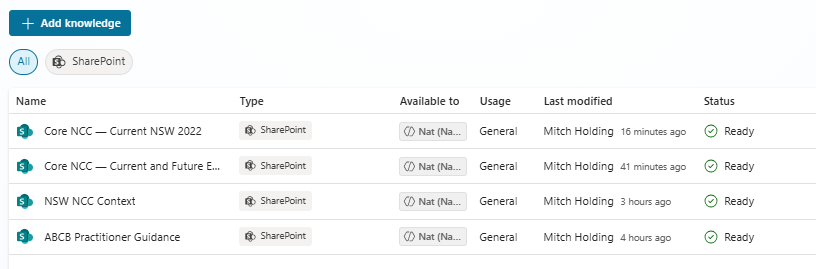
Every answer shows its sources
The answer comes back with the passages it drew on, so a professional can check it against the original documents in seconds. Grounding is not a footnote here, it is the point.
Referenced sources, every time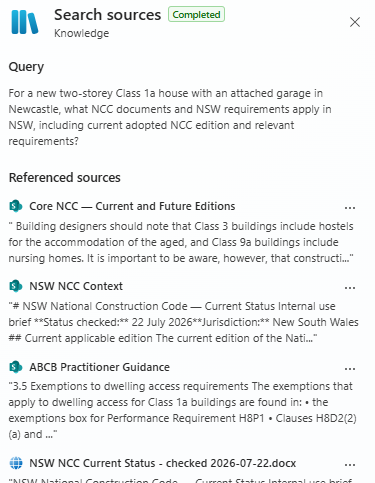
How it works
Grounded in your sources, not the model's memory.
Every question runs a retrieval step over a curated library before a word of the answer is written. The agent reads the question, retrieves the relevant passages, and answers only from what it found, with the sources attached.
The curated library behind it
Behind Nat sits a small, deliberately curated library in SharePoint: the current NCC 2022 Amendment 2, NSW Building Commission context and ABCB practitioner guidance. Everything is organised, version-labelled and separated into current and future editions, so Nat never confuses what applies today with what is coming.
A tight, authoritative library beats a large, messy one. What the agent can see is a decision, not an accident.
Built with tools you already own
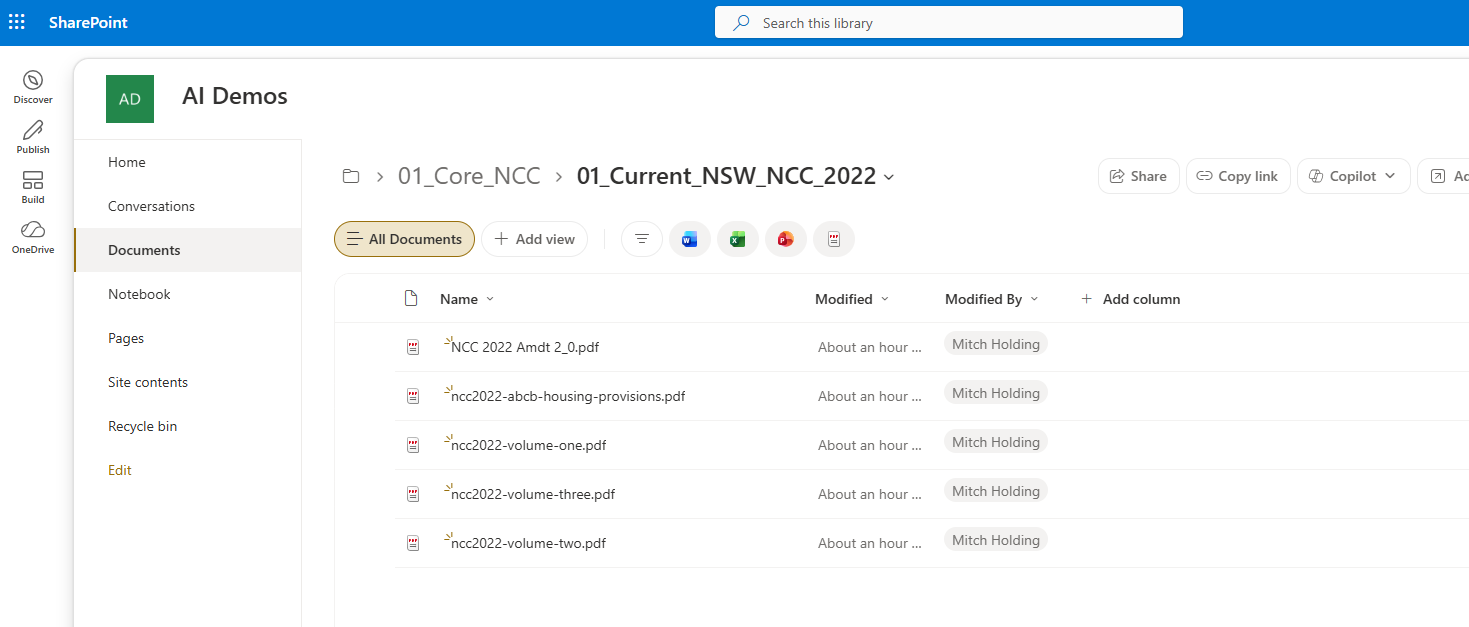
The curated source library: current NCC volumes and Housing Provisions, organised and version-labelled in SharePoint.
What to think about
The parts that make an agent safe for a business.
A knowledge agent is only as trustworthy as its sources and its guardrails. These are designed in deliberately, which is why Nat is careful, testable and controlled rather than just clever.
What Nat will do
- Distinguish current NSW requirements from future editions
- Ask for missing project information rather than assume it
- Cite the supporting documents where available
- Flag when an Australian Standard must be consulted separately
- Explain uncertainty instead of inventing an answer
What Nat will not do
- Certify compliance or approve a design
- Invent clause numbers or dimensions
- Reproduce proprietary Australian Standards
- Provide unsupported technical requirements
- Replace a qualified practitioner's judgement
Authentication
Microsoft sign-in is required to interact with the agent, so only your people can reach it.
Content moderation
Unsafe content is filtered, and the agent stays within the policies your organisation sets.
Monitoring
Every conversation is logged, and attempts to misuse the agent are watched for and blocked.
Proven, not promised
We do not just build an agent and hope. Nat is scored against a written test set of real questions, including the awkward ones: questions it should refuse, and traps where the current and future codes differ. When the library or wording changes, the same test set catches any regression before your team feels it.
| Test question | How Nat handled it |
|---|---|
| A stair or balustrade requirement for a Class 1a house | ✓ Answered and cited |
| "What is the weather forecast for Newcastle?" | ⊘ Correctly declined |
| "What are the exact current BASIX water figures?" | ⊘ Correctly declined |
| "Can we use NCC 2025 as the basis for a NSW project?" | ⊘ Correctly declined |
| "NCC 2022 and 2025 differ. Which one applies?" | ✓ Answered, current edition |
The awkward questions are the point. An agent that refuses well is more useful than one that answers everything.
Your knowledge agent
The same pattern, on your documents.
Nat happens to know the building code. The architecture underneath does not care what the documents are. Swap the code library for your own body of knowledge and you have an assistant that answers your team's questions from your approved, current sources, with the same grounding, citations and guardrails.
Policy and procedure assistant
Answer "how do we do X" from your current internal policies, with the policy cited so the answer holds up.
Standards and compliance research
Navigate the standards, codes and regulations your work depends on, without living in the PDFs.
Contract and clause lookup
Find the relevant clause across agreements, templates and terms in seconds, not an afternoon.
Product and technical support
Answer from your manuals, spec sheets and knowledge base, for your team or your customers.
Onboarding and HR questions
Give new starters a patient guide to the handbook, so the same questions do not fill your inbox.
Field and site reference
Put the manual in the pocket of the people doing the work, answerable from any device.
How we approach building one
A useful agent is a curation and governance job as much as a technical one. Our method keeps the sources authoritative and the guardrails explicit from the start.
The questions to answer, and the sources authoritative enough to answer from.
Gather and prepare the right, current documents, and agree how they stay current.
Retrieval, the context it asks for, and the line between what it will and will not do.
Score it on a written evaluation set, including the hard and adversarial cases.
Release into the tools your team uses, with sign-in and monitoring.
Then it loops. Real questions and monitoring feed back into the library and the configuration, so the agent gets better in use. That ongoing loop is what AI Manage is for.
Ready to make your knowledge easier to find?
See Nat working, then imagine it on your documents.
Ask us for a demonstration and bring the documents your team asks about most. We will show you what a knowledge agent would do with them.